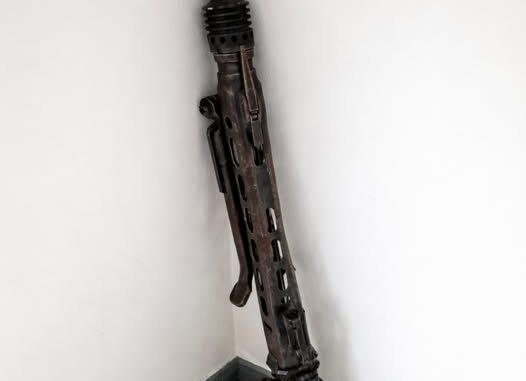
The item shown and described is a World War II German MG 42 (Maschinengewehr 42), a 7.92×57mm Mauser belt-fed machine gun known for its very high cyclic rate of fire and mass-production design. The listing describes a transferable “Class III” example (a U.S. legal category for certain registered automatic firearms) offered with extensive accessories and an estimated value of $40,000–$60,000.
- A long, dark metal firearm leaning in a corner, with a perforated barrel jacket/shroud and visible folded bipod hardware near the front area.
- Overall appearance consistent with the MG 42 family silhouette: long receiver line, vented shroud, and military finish/patina.
Name and Identification
- Official name: MG 42 (Maschinengewehr 42)
- Type: General-purpose / light machine gun (WWII German service weapon)
- Caliber (as described): 7.92 mm Mauser
- Barrel length (as described): 21 inches
- Finish (as described): Phosphate/blue
- Furniture (as described): Walnut buttstock
When It First Appeared
- The MG 42 entered German wartime production and service during World War II, with the model designation indicating 1942 as its introduction period.
Who Created It
- The MG 42 was developed for German military service during WWII and produced by multiple wartime manufacturers. The listing specifically highlights production by:
- Gustloff Werke (Suhl) (described as the manufacturer indicated by receiver markings/codes)
- Additional major wartime producers noted in the text include Mauser, Maget (Berlin), and Steyr.
What It Was Designed to Do (Purpose and Use)
The MG 42’s primary purpose was to serve as a high-volume automatic support weapon for infantry units. In practical terms, it was built to:
- Provide sustained suppressive fire using belt-fed ammunition.
- Be transportable by infantry, supporting squad-level tactics.
- Enable quick barrel swaps to reduce overheating during prolonged firing (a major point in the description).
Key Innovations and Why the MG 42 Was Notable
The listing emphasizes several design features that made the MG 42 stand out for its era:
- Stamped-steel mass production:
- Large portions were made from stamped components that were welded or riveted, reducing machining time and speeding output.
- Locking system (as described):
- A delayed roller-locking mechanism is cited as part of its engineering approach.
- Quick-change barrel:
- Designed so a trained user could swap barrels rapidly without tools, helping manage heat during extended firing.
- Very high cyclic rate (as described):~1,200 rounds/minute
- This figure is often referenced historically and is included in the provided text.
Production and Historical Scale (As Described)
- The description claims German factories produced well over 400,000 MG 42 units during WWII, reflecting its role as a widely issued weapon system.
Manufacturer Codes and Markings (As Described in the Text)
Collectors often assess MG 42s by factory codes, inspection marks, and matching parts. The listing highlights:
- Receiver marking: “M.U./5301/h/dfb” indicating manufacture associated with Gustloff-Werkes-Suhl and wartime code “dfb.”
- Top cover markings and inspection stamps (examples given): “Eagle/WaA510” and other Waffenamt proofs.
- Sights: Tangent rear sight marked 2–20 (interpreted as 200–2,000 meters).
- Buttstock marking: “hvg/44” (suggesting a wartime-dated component in 1944).
- Registration stamp noted: “CELCO/KC/Mo.” (described as the registrant/manufacturer marking in the U.S. context).
What’s Included (Accessories Listed in the Description)
The package is described as unusually complete, including:
- Five MG 42 barrels
- Four WWII barrels and one post-war barrel chambered in 7.62 NATO
- Two barrel carriers
- Three MG 34 drum/basket magazines and one MG 34 carrier
- Ammunition cans containing spare components (described as a spare top cover and feed tray)
- Linker/delinker with crank handle (for working with linked ammunition belts)
- Large folding tripod mount with:
- Anti-aircraft sight
- Adapter/extension rod
- Field kit, described to include:
- Asbestos glove
- Oilers
- Wrenches (barrel/MG tools)
- Ruptured shell extractor
- Cleaning brush and pull-through cleaning rope/brush
- All stored in a green canvas carrying pouch
- Tripod-mounted range finder with metal storage case
Why It’s Considered “Rare” in the Collector Market
A WWII MG 42 can command high prices—especially when it is:
- Original wartime manufacture with identifiable factory codes
- Described as fully functional and legally registered (in jurisdictions where applicable)
- Accompanied by matching components and a large set of correct accessories (extra barrels, mounts, drums, tools)
- Preserved with visible inspection/proof marks and historically consistent parts
Important Note (Safety and Legal Context)
This is a highly regulated military firearm in many countries. Ownership, transfer, and display rules can be strict and vary widely by location. If you are handling historical weapons for collection or display, follow local laws and professional safety practices.
Leave a Reply